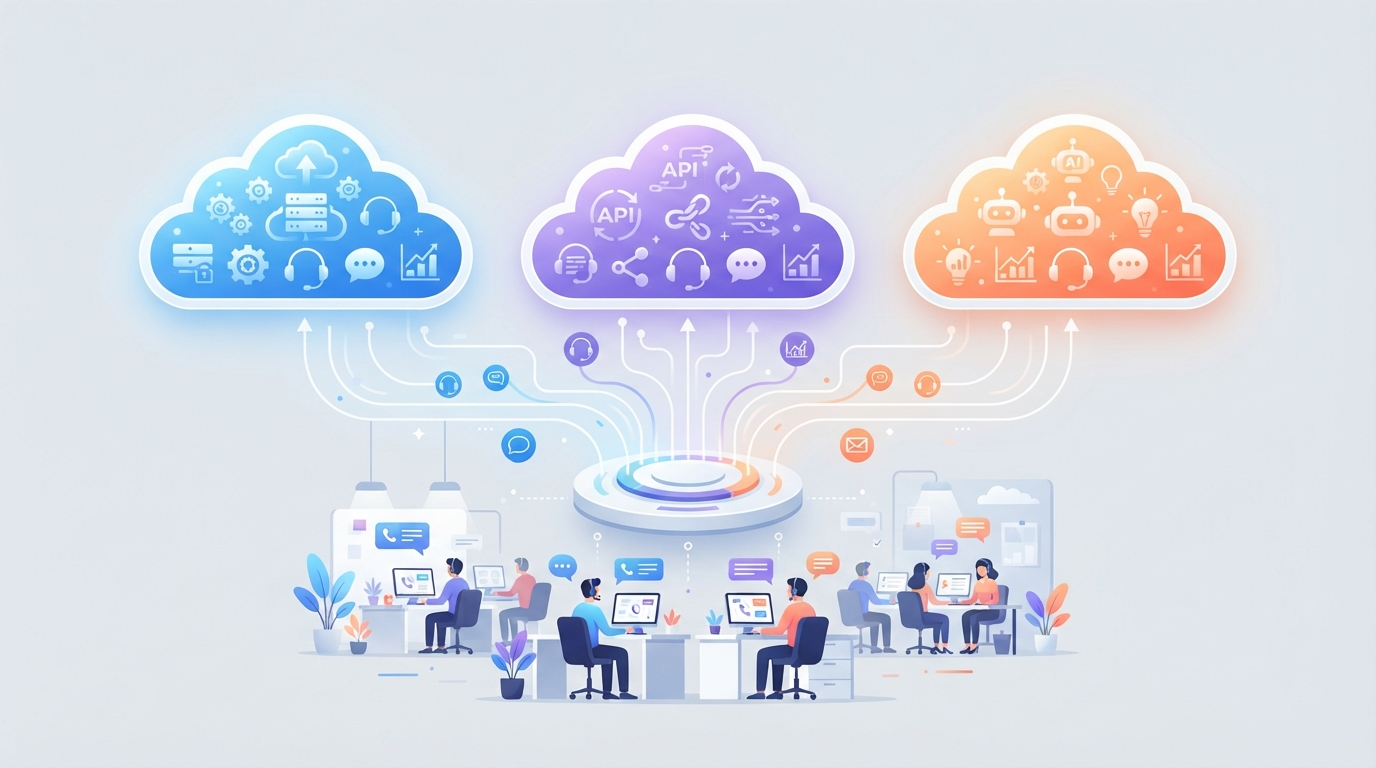
Choosing a contact center platform used to come down to call routing, IVR flexibility, and per-seat pricing. That’s no longer the whole decision. In 2026, the platform you choose is really a decision about which AI foundation your contact center will be built on for the next five to ten years — how well it handles agentic AI, how easily it integrates with your existing cloud stack, and how transparent the economics are as you scale.
Amazon Connect, Genesys Cloud, and NICE CXone are the three platforms most enterprises shortlist. Each has a genuinely different architecture and philosophy, not just a different logo. Here’s an honest, vendor-neutral breakdown of where each one stands out — and where each one falls short.
A note on pricing: all three vendors use consumption- or seat-based models that vary significantly by contract size, region, and negotiated terms. Rather than quote figures that go stale within months, this post focuses on pricing structure and transparency, since that has a bigger impact on total cost of ownership than any single number.
The Short Version
| Amazon Connect | Genesys Cloud | NICE CXone | |
|---|---|---|---|
| Best for | Organizations already on AWS; teams wanting deep customization | Enterprises wanting an all-in-one CX suite with strong workforce engagement tools | Large enterprises prioritizing AI-driven analytics and compliance-heavy industries |
| AI stack | Amazon Q in Connect, Bedrock, Lex — modular, build-your-own | Genesys AI (built-in, more turnkey) | Enlighten AI (strong in analytics, sentiment, and compliance) |
| Pricing model | Pay-as-you-go, usage-based, highly granular | Bundled licensing tiers | Bundled licensing tiers, often enterprise-negotiated |
| Implementation complexity | Higher — more flexible but requires integration expertise | Moderate — more out-of-the-box | Moderate to high, especially for full suite deployments |
| Ecosystem | Native AWS (S3, Lambda, SageMaker, Bedrock) | Strong native workforce engagement (WEM) suite | Strong compliance and workforce management heritage |
Amazon Connect
Strengths
Amazon Connect’s core advantage is that it isn’t really a standalone contact center product — it’s a contact center built natively inside AWS. If your organization already runs on AWS, that changes the calculus significantly: your contact center data can sit in the same environment as your data lake, your CRM integrations, and your AI/ML pipelines, without building custom connectors to bridge separate cloud ecosystems.
Its AI capabilities — Amazon Q in Connect for real-time agent assistance, Amazon Lex for conversational IVR, and direct access to Bedrock’s foundation models — are modular building blocks rather than a single locked-in AI product. That’s powerful for teams with engineering capacity, since you can build agentic AI workflows tailored to your exact use case instead of working within a vendor’s pre-built AI feature set.
Pricing is usage-based down to the minute and the API call, which means smaller or seasonal operations aren’t paying for idle license seats.
Where It Falls Short
That same flexibility is a double-edged sword. Amazon Connect is closer to a toolkit than an out-of-the-box solution — organizations without in-house AWS expertise or a strong systems integrator partner often underestimate the implementation lift. Workforce engagement management (scheduling, forecasting, QA) is thinner natively and typically requires third-party or AWS partner add-ons.
Best Fit
Organizations already invested in AWS, teams with engineering resources or an experienced implementation partner, and any business that wants granular control over its AI roadmap rather than a fixed feature set.
Genesys Cloud
Strengths
Genesys Cloud is the most “batteries-included” of the three. It bundles omnichannel routing, workforce engagement management (WEM), and Genesys AI into a single, cohesive platform designed to work well immediately after deployment. For organizations that want strong out-of-the-box workforce management — scheduling, forecasting, gamification, coaching — Genesys has one of the deepest native offerings in the market.
Genesys AI has matured significantly and now covers predictive routing, AI-powered summarization, and agent copilot features without requiring the buyer to stitch together separate AI services.
Where It Falls Short
That completeness comes at the cost of flexibility. Customizing workflows outside Genesys’s intended paths can be harder than in a more open, API-first architecture like Amazon Connect. Licensing is typically tiered and bundled, which can mean paying for capabilities your team doesn’t fully use, especially at smaller scale. Deep integration with non-Genesys ecosystems (particularly AWS-native data and ML tooling) generally requires more middleware than Amazon Connect.
Best Fit
Enterprises that want a comprehensive, mature CX suite without heavy in-house engineering investment, and that place a high priority on native workforce engagement tools.
NICE CXone
Strengths
NICE has one of the strongest heritages in contact center analytics and compliance, and it shows. Enlighten AI — NICE’s AI suite — is particularly strong in sentiment analysis, compliance monitoring, and interaction analytics, making CXone a common choice in heavily regulated industries like financial services, insurance, and healthcare.
CXone also offers a genuinely broad feature set spanning routing, WFM, quality management, and AI, with a strong track record in large, complex enterprise deployments and a long history of compliance-focused certifications.
Where It Falls Short
As with Genesys, the breadth comes bundled — pricing tends to be structured around suite tiers rather than granular usage, which can make it harder to right-size cost for organizations with fluctuating or seasonal volume. Full-suite deployments can also take longer to implement given the number of interconnected modules involved.
Best Fit
Large enterprises in compliance-heavy industries that prioritize analytics depth, sentiment/compliance monitoring, and are comfortable with a more suite-oriented licensing structure.
How to Actually Decide: Match the Platform to Your KPIs
Rather than picking a “winner” in the abstract, map each platform against the KPI categories that matter most in an AI-driven operation (see our related post on Contact Center KPIs That Matter in the Age of AI):
| KPI Category | Amazon Connect | Genesys Cloud | NICE CXone |
|---|---|---|---|
| AI/Automation flexibility | Highest — build custom agentic workflows | Moderate — strong turnkey AI, less custom | Moderate — strongest in analytics-driven AI |
| Cost transparency at scale | Highest — granular usage pricing | Moderate — tiered bundles | Moderate — tiered bundles |
| Native workforce engagement | Lower — needs add-ons | Highest | High |
| Compliance & sentiment analytics | Good, via Bedrock/Q integrations | Good | Highest |
| Implementation speed | Slower without a strong SI partner | Faster out-of-the-box | Moderate |
If your organization’s biggest priority is AI customization and AWS-native integration, Amazon Connect wins. If it’s turnkey workforce engagement, Genesys Cloud wins. If it’s compliance and analytics depth, NICE CXone wins.
A Note on Migration
Platform comparisons rarely happen in a vacuum — most organizations evaluating this decision are also weighing the cost and risk of migrating off a legacy system (Avaya, Cisco, or an aging on-prem deployment). That migration complexity should be part of the decision, not an afterthought once the platform is chosen. A phased, low-risk migration approach matters more to total cost of ownership than the sticker price of any single platform.
The Bottom Line
There’s no universally “best” platform among Amazon Connect, Genesys Cloud, and NICE CXone — there’s only the best fit for your existing cloud ecosystem, your team’s engineering capacity, and the specific KPIs you’re optimizing for. Organizations already running on AWS with the appetite to build custom AI workflows tend to get the most long-term value from Amazon Connect’s flexibility and usage-based pricing. Organizations that want AI and workforce engagement to work well on day one, with less internal engineering lift, often lean toward Genesys or NICE.
Not sure which platform fits your operation? Talk to Data Sleek’s Amazon Connect experts for an honest, needs-based assessment — including what a migration path would actually look like for your environment.