
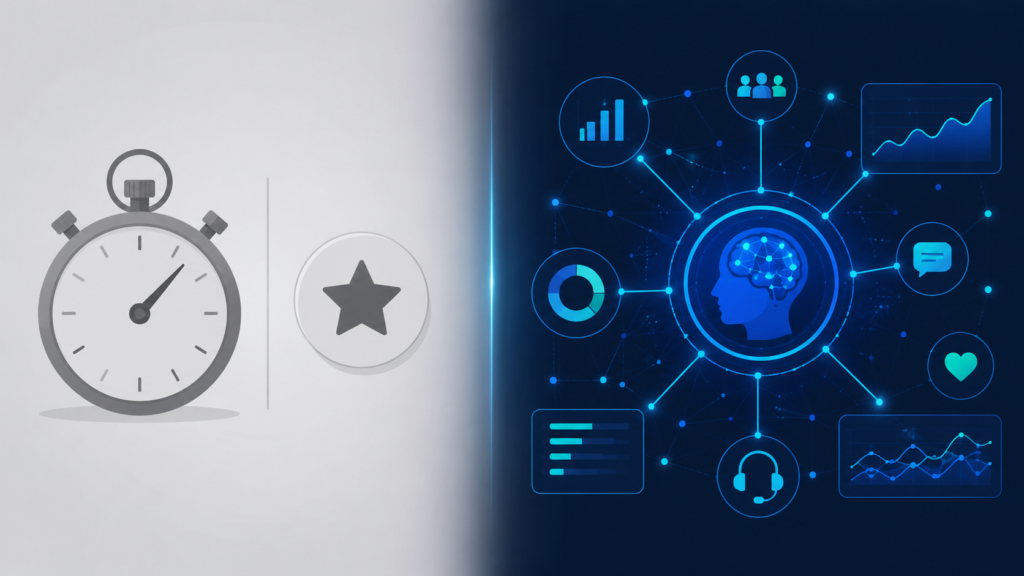
For decades, Average Handle Time (AHT) and Customer Satisfaction (CSAT) have been the default scoreboard for contact centers. They’re easy to measure, easy to report to leadership, and easy to compare quarter over quarter.
But they were built for a world where every interaction was handled by a human agent, start to finish. That world doesn’t exist anymore.
Today’s contact centers run on a mix of AI agents, agent-assist copilots, self-service bots, and human agents handling the interactions that actually need a human. When AI resolves a routine password reset in eight seconds, is that a “good” AHT — or a metric that no longer means what it used to? When a customer rates a bot interaction 3 stars because it correctly told them “no” to a refund request, is that a CSAT problem — or CSAT working exactly as intended?
This is the core issue: AHT and CSAT were never designed to measure a hybrid human-AI operation. Leaders who keep steering by these two dials alone are flying with an incomplete instrument panel.
Below is a practical framework for the KPIs that actually matter now — organized by what they measure and why they matter more than the old standbys.
Why AHT and CSAT Fall Short in an AI-Driven Contact Center
Before replacing anything, it’s worth being precise about why these legacy metrics break down:
- AHT rewards speed, not resolution. A bot can close a ticket in 12 seconds without solving the customer’s problem — and AHT looks fantastic while customer effort quietly climbs.
- AHT can’t be fairly compared across channels. A five-minute voice call and a 40-message asynchronous chat aren’t measuring the same thing, and AI now handles a growing share of chat and messaging volume.
- CSAT is a lagging, low-response-rate signal. Typical CSAT survey response rates hover in the single digits to low teens, meaning most scores are built on a small, self-selected slice of customers — usually the very happy or very unhappy.
- CSAT doesn’t distinguish why someone was dissatisfied. A correct-but-unwelcome answer from an AI agent (a denied claim, a policy explanation) can tank CSAT even though the agent did its job correctly.
- Neither metric captures containment, deflection, or automation quality — which are now some of the biggest cost and experience levers in the building.
None of this means retire AHT and CSAT. It means stop treating them as the whole picture.
1. AI & Automation Performance Metrics
These measure whether your AI layer — bots, IVAs, agent-assist tools — is actually doing its job, not just deflecting volume.
Containment Rate (and Quality-Adjusted Containment Rate)
The percentage of interactions fully resolved by AI/self-service without human escalation. The important twist: track a quality-adjusted version that excludes containments where the customer abandoned, re-contacted within 24–48 hours, or gave the bot a low rating. Raw containment rate can be gamed by an AI that’s aggressive about closing tickets; quality-adjusted containment can’t.
Escalation Rate & Escalation Reason Codes
What percentage of AI-handled interactions get kicked to a human, and why? Segmenting escalation reasons (intent not understood, policy exception, customer requested human, sentiment-triggered) tells you exactly where to invest in bot training versus where a human will always be required.
AI Resolution Accuracy
Distinct from containment — this measures whether the AI’s answer was actually correct, sampled and audited against a quality rubric, similar to how QA teams score human agents. A bot can contain a conversation with a wrong answer.
Deflection-to-Resatisfaction Ratio
Tracks how many customers deflected to self-service later contact the center again for the same issue within a defined window. High deflection with high repeat-contact is a red flag that automation is closing tickets, not closing loops.
2. Customer Effort & Experience Metrics
Effort is emerging as a stronger predictor of loyalty than satisfaction — and it’s especially relevant when customers are bouncing between bots and humans.
Customer Effort Score (CES)
Asks a simple question: “How easy was it to get your issue resolved?” In AI-heavy environments, CES catches friction that CSAT misses — like a customer who got the right answer but had to repeat themselves three times across a bot-to-agent handoff.
Channel-Switching / Handoff Friction Rate
Measures how often a customer has to repeat information or context is lost when a conversation moves from bot to human (or human to bot). This is one of the most common AI-era failure points and one of the easiest to fix with the right architecture.
First Contact Resolution (FCR) — Redefined for Hybrid Journeys
FCR still matters, but it needs to be tracked across the full journey, not just within a single channel or single agent interaction. A customer who starts with a bot, gets escalated, and is resolved by a human in the same session should count as one FCR event — not two separate, disconnected interactions in two different dashboards.
3. Business Impact & ROI Metrics
These are the metrics that get AI investment approved — and renewed.
Cost Per Resolution (Not Cost Per Contact)
Cost per contact treats every interaction the same. Cost per resolution accounts for the fact that AI-resolved contacts and human-resolved contacts have very different cost structures — and lets leadership see the true blended economics of the operation.
Automation ROI / Cost Avoidance
Calculated as (volume successfully contained by AI × average cost of a human-handled equivalent interaction) minus AI platform and maintenance costs. This is the number that justifies the next AI investment to finance.
Revenue Influence Rate
For contact centers with any sales, retention, or upsell function, this tracks the percentage of AI-assisted or AI-handled interactions that contribute to revenue outcomes — renewals saved, upsells completed, churn prevented.
4. Agent Experience & Augmentation Metrics
AI’s biggest near-term impact isn’t replacing agents — it’s changing what they do. That needs its own scorecard.
Agent Assist Adoption & Adherence Rate
What percentage of eligible interactions actually use the AI copilot (real-time suggestions, auto-summaries, knowledge surfacing) — and how often do agents follow its recommendations? Low adoption signals a trust or usability problem with the tool, not the agents.
Time-to-Proficiency for New Agents
With AI-assisted onboarding and real-time guidance, new agents should be reaching full productivity faster. Tracking ramp time before and after AI-assist rollout is one of the clearest, most boardroom-friendly ROI stories available.
Agent Sentiment / Wellbeing Trend
AI is changing agent workload and the emotional texture of their day (more complex, higher-stakes calls; less repetitive work). Regularly pulsed agent sentiment data helps catch burnout risk before it shows up in attrition numbers.
Building a Balanced AI-Era KPI Dashboard
A good rule of thumb: for every efficiency metric, pair a quality metric, and for every AI metric, pair a human-experience metric. For example:
| Efficiency / Volume | Paired Quality Check |
|---|---|
| Containment Rate | Quality-Adjusted Containment Rate |
| AHT | Customer Effort Score |
| Automation Cost Savings | Automation ROI (net of investment) |
| Agent Assist Adoption | Agent Sentiment Trend |
This pairing prevents the classic trap: optimizing a number that looks great on a dashboard while quietly eroding the experience it was supposed to protect.
How Amazon Connect Makes These KPIs Measurable
Legacy contact center platforms weren’t built to report on bot-to-human handoffs, quality-adjusted containment, or blended cost-per-resolution — because those concepts didn’t exist yet. Amazon Connect, paired with Contact Lens analytics, Amazon Q in Connect, and Bedrock-powered AI agents, is architected for exactly this kind of hybrid measurement: every interaction, whether it touches a bot, an AI agent, or a human, lives in the same data model and can be tracked end-to-end.
That’s the real shift underway in contact center analytics — not just new metrics, but a data architecture that can finally see the whole journey instead of fragmented pieces of it.
The Bottom Line
AHT and CSAT aren’t obsolete — they’re incomplete. In a hybrid human-AI contact center, they need to sit inside a broader framework that also measures automation quality, customer effort, blended cost economics, and agent experience. The contact centers that get ahead in 2026 and beyond won’t be the ones with the lowest AHT — they’ll be the ones with the clearest, most honest picture of what’s actually happening across every interaction, human or AI.
Ready to rebuild your contact center’s measurement strategy for the AI era? Talk to Data Sleek’s Amazon Connect experts about designing a KPI framework that matches how your operation actually works today.